

Grow Week 3
April 26, 2026
View Transcript
Introduction
All right, good morning everyone. Glad to see you here and glad to have all the folks who are joining us in Robertsdale and everyone else who’s joining us online. Today we’re going to continue the series that we’ve been in for the last couple of weeks, which is on spiritual growth, entitled Grow.
Just a quick recap: in week one of the series, we learned that the expected trajectory of a Christian life should be spiritual growth. Once we come to know Christ, then the trajectory our life should be on is continued spiritual growth. We saw last week — Pastor Chris pointed out to us — that our commitment to God’s word is essential to our spiritual growth. So we have to have a firm commitment to the word: being in the word, believing the word, to help us to grow spiritually.
Now this week, what we’re going to do is look at some practices that will help us to continue to grow over the course of our lifetime. Spiritual growth is not just for a season of our life. It’s for the entirety of our lifetime. And there’s a little formula I want to give you, and I want you to keep this in mind throughout the teaching as we make the various points about these practices. It simply says this: consistency plus time equals spiritual growth. So consistency is doing the right things and doing them consistently. But again, not in the short term, but over the long haul — doing those things that will produce growth all the way through the entirety of our life. Now keep that in the back of your mind.
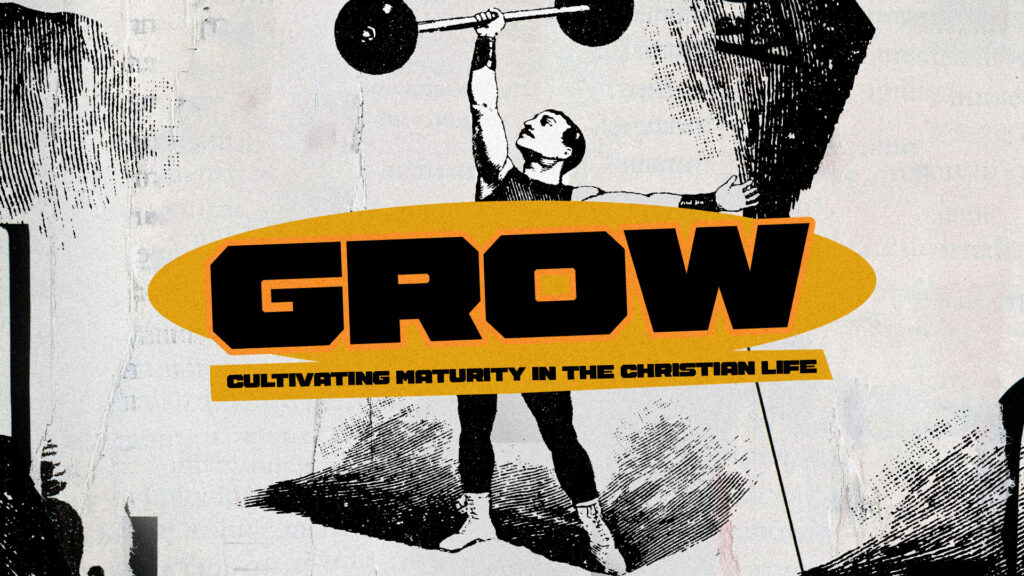
But before we jump into our teaching, I want to go ahead and address what is probably a question that is at the forefront of everyone’s mind this morning. And that is: in a series that is on spiritual growth, that graphic has this muscle builder holding a barbell over his head, and whose content — the repeated references have been about going to a gym — why in the world do they ask me to teach? It’s a good question, because do I look like I go to a gym? Well, the only answer I can come up with is, really, I don’t know why they asked me in this series, other than I’ve got this sneaking feeling that it was all just a prank, just to poke at me just a little bit. But I learned a long time ago the message is more important than the messenger. So let’s focus on the message and not so much on the messenger today, and I think we’ll be okay.
Confidence Through the Curtain
So let’s jump into today’s teaching. Let’s look at Hebrews chapter 10, beginning with the 19th verse, going through verse 21 to begin with. It says: “Therefore, brothers, since we have confidence to enter the holy places by the blood of Jesus, by the new and living way that he opened for us through the curtain, that is, through his flesh, and since we have a great priest over the house of God…” And let’s just stop right there.
The first thing I want you to notice is that at the beginning, looking at verse 19, he said, “Since we have confidence” — some translations will use the word “boldness.” So since we have confidence, since we have boldness, there are some things that we can do, and we should do them boldly or confidently, and those things will help us to grow spiritually.
But what does he actually mean by confidence? You know, if you ask some people today what confidence means, they’ll define it this way: it’s believing in myself. “I believe in myself, and that gives me confidence to do whatever it is.” You ask athletes, “What gives you confidence?” “I believe in myself. My talent, my ability.” That’s not at all what he’s talking about here. In fact, the confidence that he’s describing is the result of having a settled mind in regard to what Christ has accomplished for us at Calvary — to know what’s been done for us and to have that settled in our mind, that that is truth, and that I’m going to hold to that truth. And so believing that should give us confidence to do some things that he’s going to describe.
But he also gives us a snapshot of what Christ has accomplished for us. He says in verse 20, he’s provided a new and living way of access to God. Which really means — and it’s an amazing thing — that Jesus opened or inaugurated a way into the presence of God that was previously nonexistent for the average person. He opened up something for us that had not been available until the work that he did at Calvary.
Now, what makes this possible? What makes this new and living way, this access to God, possible? He says that it’s “through the curtain, that is, through his flesh.” Now, he’s referring to the curtain — sometimes translations will use the word “veil.” What he’s referring to is the curtain or veil in the temple that was placed there to separate us from the presence of God. The presence of God was behind it, at the ark of the covenant. That was where God dwelt. But no one could go back there except one person — the high priest — once a year. And he had to be careful going back there, because if he didn’t purify himself right, if he didn’t follow all the cleansing protocols, if he walked back there, he would drop dead. And so this curtain separated us from God.
But what the word of God is telling us is that when Jesus Christ, when his flesh was torn, that spiritual barrier between heaven and earth, that spiritual barrier between God and man, was removed. And it was visualized or symbolized by what happened to that curtain in the temple in that moment when Jesus Christ uttered those words, “It is finished,” and embraced death. The word of God says that that veil, that curtain — now understand exactly what it’s saying. This thing wasn’t a veil, thin and flimsy. It was 60 feet tall, 30 feet wide, four inches thick. It was said that horses could not pull it apart. It took 300 men, when it was part of the mobile tabernacle, to take it down, transport it, and hang it back up. And when it says “curtain,” you should not think of decoration. We put curtains in our house to decorate. No — this was a spiritual barrier. And it says that when Jesus embraced death, that thing was torn from the top to the bottom, illustrating that man didn’t do it, because it wasn’t torn from the bottom up. It was torn from the top down, symbolizing that man now has access to God. He prepared a way for us to bring us into the presence of God.
And it says that now, because of that, we have a great priest over the household of God. Which means he manages and supervises our access into the presence of God, that he ensures that our prayers and our worship are acceptable to the Father. And to use the writer of Hebrews’ words: therefore, since we have confidence in that work, and believe and trust in that work, then there are some things that we can do that will help us grow over the long haul.
Now, what’s going to follow are three “let us” statements. Three statements that begin with “let us.” But I want you to add a little something to that, because in the Greek language it literally says, “Let us continually.” So whatever these practices are, he says, “Let us continually do them.” Remember the formula: over the long haul, consistency plus time equals spiritual growth. So we’re going to do these things consistently over time.
Let Us Draw Near
So what are they? Verse 22, he says, “Let us draw near with a true heart in full assurance of faith, with our hearts sprinkled clean from an evil conscience and our bodies washed with pure water.” So he says, “Let us draw near” — but again, it says, “Let us continually draw near.” It should be a practice of ours. And what he’s encouraging us to do is to take advantage of the open door that Jesus created with his sacrifice at the cross. Take advantage of that. Come into the presence of God.
Now, there are a lot of ways we can draw near to God. We can do that through worshiping as we gather together like this. We can do it in reading and meditating on God’s word. We can do it in prayer. All kinds of ways. But we have to understand that what he’s calling us to is not a ritual, not some plan, some program, some process — not some reading plan, not some study plan. He’s calling us to a relationship with God. To draw near to him for relationship. It is a lifelong invitation, a lifelong call to continual communion and fellowship with God.
And what a contrast, if you realize who he’s writing to. The writer of Hebrews — the primary audience are Jewish converts, individuals who grew up in Judaism. They know all about being separated from God. Now, as they enter into accepting Christ as their Lord and Savior, all of a sudden, they’re not told to stay back from God. They’re told to draw near to God. It was a revolutionary concept for them. I mean, they remember — just like we studied in the Mosaic system — that when God invited Moses up into the mountain to commune with him, he gave strict orders: “While my presence is in the mountain, no one is to come near the mountain.” He even told them, “If an animal touches the mountain, it’ll die. If a human being touches the mountain, they will die.” In other words, their whole history was about staying back from God. And now they’re told, “Draw near to God. Come into his presence. Come to him for relationship.”
So what are the characteristics of drawing near to God? Well, it’s an active pursuit. It implies a conscious, intentional choice to seek God. It’s not a passive thing. We don’t just accidentally end up in the presence of God. Drawing near to God requires active, daily effort. Because without that daily effort, that conscious effort to draw near to God, we would naturally drift away from God instead of drawing near to God — because we would be pulled away by this world, by our sinful flesh, and by the spiritual forces at work in the world. So we have to be active. It has to be a conscious, intentional effort.
But it’s also based on faith, not perfection. There are some individuals that say, “I just feel ashamed to come into the presence of God. If you knew what I had done — if you just knew what’s been a part of my life, how sinful I have been.” But it’s based on faith, not perfection. We’re in the process of perfection. We’re in the process of growing spiritually. So we don’t wait till we’re perfect to come into the presence of God. It’s based on faith. You see, the encouragement is to approach God according to his word, with a full assurance of faith, knowing that Christ has cleared the way for us to enter into his presence. It means that we can approach God with the assurance that we’re welcome there, that we’re supposed to be there, that we’ve been invited to be there.
You know, a couple of weeks ago, I bought my season football tickets for Jacksonville State football games, because my grandson plays there and I want to go watch him play. And because I know that if I show up without a ticket, they’re not going to let me in. I can tell them who I am. I can tell them how far I’ve driven. I can tell them all kinds of things, but they’re still not going to let me in. The only way they’re going to let me in is when I hold up my phone and show them that digital pass that I have, and they shoot it with that little scanner, and a little green light goes off and a little beeping sound sounds, and then they step aside and say, “Enjoy the ball game.” Why? Because that ticket was my authorization to be allowed to come into the stadium. The question for us then is always: what is our authorization to draw near to God? Is it because of who you are? Is it because of your accomplishments? Is it because of the things you’ve done in life? No. Our authorization — he says it right here — is “we come with our hearts sprinkled clean from an evil conscience and our bodies washed with pure water.” In other words, I get to come into his presence because those things that he described there in the Greek language are completed acts. In other words, I am sprinkled clean. I am washed clean. I am pure. It’s been done in the past, and my authorization is the work that Jesus Christ did at Calvary that made that possible for me.
Charles Spurgeon made a statement — and to be honest with you, every time I think of a statement and I’m not really sure who I heard it from, I always say Charles Spurgeon, because I read a lot of Charles Spurgeon, and more than likely if it’s really a good one, that’s where I read it. So I think Charles Spurgeon said this, and basically what he said was that it’s a thing to be celebrated that when we draw near to God, we see ourselves as sinners. So that’s part of the process of growing spiritually — that we know there are things that need to change in our lives. We know there are things that we need to clean up. It doesn’t matter if you’ve just recently come to Christ, or you’ve been serving God, been a born-again believer for 40 or 50 years. There’s still stuff in us that God’s cleaning up. The Spirit is still doing a work in us. So, sure, it makes sense that when I come into the presence of a holy God, I see myself as a sinner. But here’s what else he said: we see ourselves as sinners, but he does not. When I come into his presence, he doesn’t see me as a sinner. He sees me as the work that’s already been done. I’ve been sprinkled clean. I’ve been washed pure. I’ve been made holy. I’ve been made righteous. How? Through the work that Jesus did at Calvary. That’s what gives me confidence then to draw near to God continually. I have the right to be there, because I have the authorization that’s been made possible through Christ.
Let Us Hold Fast
So what else? Verse 23: “Let us hold fast the confession of our hope without wavering, for he who promised is faithful.” So he says, “Let us continually hold fast.” To hold fast means to tenaciously cling to, or to embrace something with force, as if someone is trying to pull it away from you. To hold on to something that is so valuable to you, you do not want to let it go.
Now, when Phyllis and I got married — our wedding day, ceremony is over, reception is over — we go to her parents’ house, which is right next door to the church where everything took place, to change clothes so that we can start the most important part of the day, which is to go on our honeymoon. I mean, I don’t remember much of the other stuff, you know. Let’s go on the honeymoon. That’s where we’re headed. And so we change, and our car is parked outside, and there’s a door from the side entrance of their house, and we’re going to go get in the car and head off on our honeymoon. And as we’re walking to the door — you know, sometimes you just get those spidey senses, just a little tingling that something’s afoot here, something’s not right. And as she approached the door, I looked out a window, and there were all kinds of relatives of hers gathered around that stoop. And there were people all up and down the walkway. And I knew something was up. And sure enough, when we opened the door and she took one step out on that stoop, all these arms and hands reached for her. And the truth is, they were going to grab her and they were going to kidnap her.
Now, I had to be careful. I said that this morning and someone came up to me deadly serious: “Did they ever find out who was trying to kidnap her?” Not literally kidnap her. You know, the intention was they were going to get her, whisk her away somewhere, thus interrupting all of my plans. So when she stepped out and I saw them reach for her, I stepped right behind her, wrapped my arms around her, and they would have had to knock me out or kill me for them to get her out of my arms. And eventually, because they realized that I wasn’t letting go, and if they kept pulling, they were going to hurt her, they decided to let go. So I was holding on tenaciously. As a matter of fact, I’ve been holding on tenaciously for 54 years now, in case somebody else decided to come along and try to snatch her away.
And so this idea of holding fast implies that we have a white-knuckled grip on our convictions, on what we believe to be true. Even when the culture or even our personal trials try to pull us away from it — we know what we believe. We know the work of Calvary is true, foundational. I believe that. But the culture will try to pull you away, and trials will try to pull you away. We know the culture. I mean, the culture is so anti-good, anti-Christian, anti-Bible, anti-gospel. I mean, we see it. They’re so opposed to anyone who aligns themselves with the truth of God’s word and says, “I’m going to live my life according to these principles.” We see it every day. Easily recognizable. That’s who they are.
But one of the big dangers is the cultural pressure that comes from within the so-called church. Because there are people who call themselves Christians and say that they’re followers of Christ, and say that they’re seminary educated, and some of them say they’re pastors, and they are prophets, and whatever other title they might want to give themselves. But the reality is that what they’re peddling is not this gospel. They paint it up in very colorful words — you know, inclusion, acceptance, affirmation, love and grace and mercy — and cloak it in those things, but it’s not this gospel. And we then need to be careful that we don’t get pulled away from the truth of this gospel by that pressure. We need to be careful who we listen to. We need to be careful what podcast we watch. We need to be careful whose books we read. We need to be careful who we watch on Christian television or whatever you listen to on the radio. We need to white-knuckle this word and not give in to any pressure that tries to change what is in the gospel of Jesus Christ.
You know, sometimes we think, “Man, we live in a time that’s so much different than all the other history.” But it’s not. It’s always been that way. Paul writing to the Galatians, in Galatians 1:8, he says — talking about himself and those with him who had helped to evangelize — “But even if we, or an angel from heaven, should preach to you a gospel contrary to the one we preached to you, let him be accursed.” In other words, whoever is doing that, they are cursed in the eyes of God. They’re cursed. We need to not let people who are cursed by God be drawing us away from the truth of God’s word. And so we need to cling to it. We need to hold on to it with all that is within us.
But sometimes what draws us away, or what pulls at our faith, are just the personal trials that we face in life. I mean, the reality is that things can come at us that we could never have anticipated, we could never have prepared for. Things can come at us in such a way that we have a multitude of questions but we have no answers, and it doesn’t seem like any answers are coming. And when those times come, Scripture encourages us: hold on. Hold fast. Man, it’s easy to hold fast, be steadfast, be immovable, be unshakable, all those things, when life is smooth. But then these things come, and we’re encouraged to do one thing: hold on. Hold fast. White-knuckle it. Don’t give up. Don’t let go.
And I know this to be true, and I believe it will be true in your life: some of the most important and significant spiritual growth that you will ever go through in your walk with Jesus Christ will come in those moments of time when all you have left to do is just hold on. Hold on. Don’t let go. You see, holding fast, you can tell by this, is not passive. It involves an irrevocable decision to believe God’s word regardless of our outward pressure or our inward doubt. You hold on.
But here’s the good news. The good news is we don’t hold on because we’re strong. We don’t hold fast because we’re strong. But as the writer of Hebrews says, we hold strong because he who promised is faithful. You see, the stability that we have — the hope that we have for today, the hope we have for tomorrow, the hope we have all the way into eternity — is anchored in God’s reliable nature. It’s anchored in God’s unchanging character. The thing that I’m anchored to is not my circumstances, which change day by day. I’m not anchored to my feelings, which change moment by moment. I’m anchored to God and his unchanging nature and character, and I can hold fast to that.
Let Us Consider One Another
Then he gives us a third one, the last one, in verses 24 and 25: “And let us consider how to stir up one another to love and good works, not neglecting to meet together, as is the habit of some, but encouraging one another, and all the more as you see the day drawing near.” So remember, it’s “let us continually consider others” if we’re going to grow spiritually. Isn’t it interesting — now it’s not about us. It’s about others. My spiritual growth is going to be connected to other people.
You know, what does it mean to consider one another? By definition, the word means to look at one another, think about one another, focus on one another, study one another, let your mind be occupied with another. And then you might ask, well, what’s the goal of that? Well, it’s not to be a stalker. You know, not to be a church stalker, where we’re just looking at somebody, staring at somebody, thinking about somebody. That’s not what it’s about. You see, he tells us that the goal is so that we can think of ways that we can stimulate, spur on, encourage one another. Verse 24, the focus, the aim — clear: let us consider how to stimulate one another to love and good deeds. But then verse 25, he gives us the directions of how we do it. This is what he says: “Not forsaking our own assembling together, as is the habit of some, but encouraging one another.” So he says two things: don’t neglect to assemble. And then, second, when you assemble, encourage one another.
Now, I’ve been in church my entire life, and I have heard this verse of Scripture used as a text — I can’t even tell you the number of times. And the vast majority of the times that it’s been used, it’s been used as a way to encourage me to be faithful to attend worship gatherings. In other words, “Do not forsake the assembling of yourselves together, by coming to church regularly.” Now, the reality is that that’s not a wrong application of the text, because one of the most important things that we can do as believers is to attend church regularly, because some of the most important kinds of encouragement and instruction that you’re ever going to get as a follower of Christ is going to come from the preaching and teaching of God’s word. So we need to come regularly. We need it. But in the context that he’s sharing it, there’s something different going on. He’s talking about a situation where members encourage one another — where something mutual is taking place, where each one is doing something and saying something that’s encouraging someone.
And if you were to ask me, “What is it at Three Circle Church that corresponds to that?” — I think the obvious one, it’s not the only one, but the obvious one is small groups. You know, those small group collectives. You see, I believe in preaching. I’ve been doing it for almost 48 years. So I believe in the power of preaching. I believe that the word of God must be preached. It must be proclaimed. But I’m under no illusion that that is all that a believer needs in their life. I think that’s part of the spiritual nutrition plan that God has for us, but it’s not all of the plan. I believe that the New Testament, especially here in Hebrews, calls us again and again to this kind of mutual ministry that involves all the believers in encouraging other believers. I believe that God’s plan for our good is that much of our encouragement come from other Christians speaking the word of God into our lives and praying for us.
It’s sort of like guys getting together and working out at the gym. At least, that’s what I’ve been told. I have secondhand information. You know, a guy’s working out and he decides he wants someone to work out with him, and so he invites someone. They invite a couple of other friends, maybe three or four friends. So they all get together and they work out together. And when they do, they encourage one another. They support one another. They challenge one another. They hold one another accountable. All those things. We see, spiritually speaking, we should have people like that in our lives. We need it. If we want to be spiritually healthy, we need to have people like that in our lives.
In verse 25, he says, “Not giving up meeting together, as some are in the habit of doing.” I think what he’s doing is issuing them a warning, that it’s so easy — and we can come up with so many excuses and so many reasons — to decide that we’re going to live our life spiritually independent: “I don’t need other people. Me and God, we’re good.” And so I’m going to live spiritually isolated and spiritually independent. It’s my belief that a Christian life lived in isolation will lack the spiritual health and vitality of a life lived in Christian community. We desperately need it.
You notice in verse 25 once more he says, “Not neglecting to meet together, as is the habit of some, but encouraging one another, and all the more as you see the day drawing near.” What’s he talking about — “the day”? Talking about the second coming of Jesus Christ. The closer we get, the more we should meet together in this life-giving community that he’s talking about. 2 Timothy 3:1 says, “In the last days, there will come times of difficulty.” So why does he say you need to meet more and more and more as you get closer to the day? Because he knows — and we will discover — that it’s never going to get easier to be a Christian than it is right now. There will be ebbs and tides, but the trajectory in this world is going to be that it gets harder and harder and harder to be a believer. And so what does he say the answer to that is? How do we deal with it? We meet. We meet. We meet. We meet. We meet. And we encourage, and we uphold, and we support, and hold accountable. That’s how we get through those times.
The Path Visualized
Remember we started with that little formula: consistency plus time equals growth. So — consistency to draw near continually, to hold fast continually, to consider one another continually. Do those things consistently over time, and spiritual growth will take place.
Now, it’s easy to say words. I’m sort of a visual learner. And so I was trying to figure out how do you visualize that. And I came up with this, and they’re going to put it on the screen — that represents a spiritual journey. Now, I don’t have to know where that is. I don’t have to know anything else about it. There are two things I can observe from that right now. That path has been walked over a long period of time. Someone has walked that path over time. But I can also tell by that path it’s still being walked on consistently today, because nature hasn’t taken over. The weeds haven’t grown in. The grass hasn’t grown in. So that path is a path that is consistently walked and has been consistently walked day after day after day after day. That’s what our life is like. That’s what our journey is like.
But here’s also something that we need to remember: we were never intended to walk our spiritual path alone. That was never God’s plan. His plan was always for us to walk it in community with someone else. And so the question for you as we end today is: who have you invited to join you on your spiritual journey? If you can list them, that’s great. If you can’t think of any, you’re depriving yourself of a big portion of the spiritual nutrition that God wants you to have.
Communion
Now, we’re going to conclude the day with communion. I think — what a great way to do it, when we have just talked about the fact that everything we discuss is based upon the work of Jesus at Calvary. I can have confidence because of what he’s done for me, not because of what I’ve done. And so I want to ask, if there’s anyone this morning who wants to participate in communion and didn’t get the elements, just hold your hand up, raise it up high and keep it up until someone gets to you. We’ve got some down front here and they’ll bring you the elements.
Some things for us to know: you don’t have to be a member of Three Circle Church or a regular attender of Three Circle Church to join in communion with us, but Scripture, I believe, is very clear when it tells us that this is something that’s reserved for believers — followers of Christ, individuals who have accepted Jesus Christ as their Lord and Savior. And so if you have not made that spiritual decision yet, then we would ask you not to participate, but to observe. And then at the end of our gathering, we’ll have some of our staff down here, and they’d be glad to answer any questions you might have about what we’ve done today.
Also, if there are children in the room — parents, we consider you to be the spiritual leaders of your home. And so if you know that your child is ready for communion, ready for the Lord’s Supper — they have accepted Christ, and you feel that they can understand what’s going on — they’re more than welcome to join you. But if not, then again, let this be a teaching moment for you to talk about what this represents.
And now, as we prepare for communion — you know, Scripture, the Apostle Paul especially to the Corinthians, told them that it’s important that we don’t just view this as some mechanical ritual. In fact, there’s something deeply spiritual that happens when we do this, and for that reason he said that you need to examine yourselves. In other words, take it seriously, and before taking the elements, allow the Holy Spirit to do a little inventory, a little search. And if there’s some unconfessed sin in your life, this is the time to confess it. If there are things between you and God, now is the time to deal with those things in prayer. And so while you allow the Holy Spirit to speak to you and as you prepare yourself for this, our team’s going to lead us in a song.
April 12, 2026
Grow Week 1
April 19, 2026
Grow Week 2
May 3, 2026
Grow Week 4