

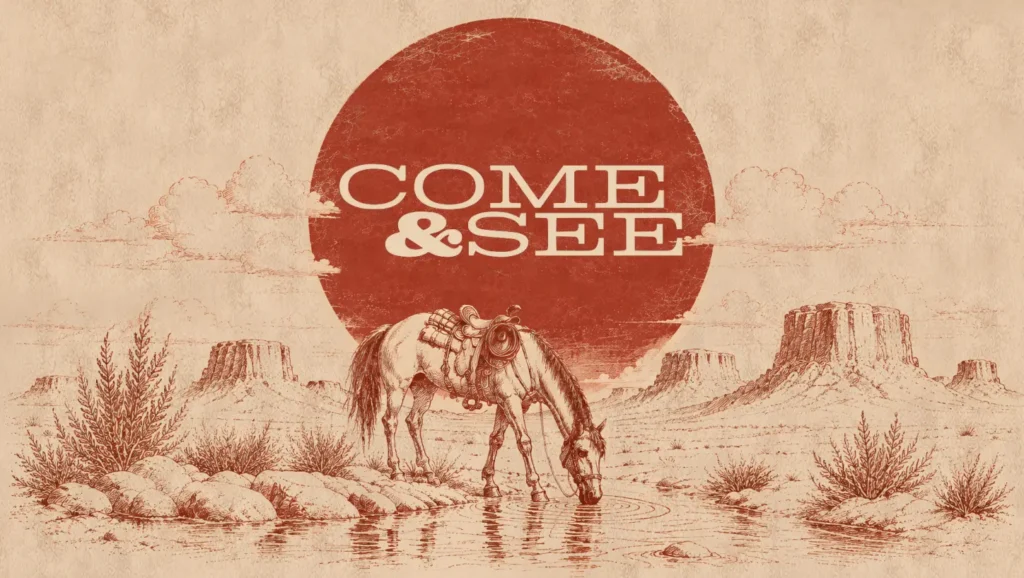
Come & See | Week 1
October 4, 2026
In this message, Pastor Russell begins the “Come and See” mini-series in John 2:1-11, where Jesus’ turning of water into wine at the wedding in Cana serves as a “sign” pointing beyond itself to his glory and authority. The message draws out how Jesus is Lord over both the ordinary and the spiritual, calling listeners to bring their needs to him, do whatever he tells them, and stop settling for empty religion when only Christ can satisfy their thirst.
View Transcript
A New Series: Come and See
Well, good morning. Good to see all of you here on a threatening-to-rain day so far. A little bit of rain here and there, but good to see that you dared to come out and be with us. Great to have you in the house, but also those that are joining us online today. As you just heard, we are still in the book of John, and we will be in the book of John for quite a while, and so for the next several months they’re sort of breaking it up into a mini series within the big series. We completed last week what we creatively called “Chapter 1,” which was a study of John chapter 1. A little more creative this time — for the next several weeks we’ll be looking at a series that we’re calling “Come and See.” Now, before we get started — we’re going to be in John chapter 2, so if you want to get your Bibles turned there, your devices scrolled to there, get ready — I want to make you aware of some resources that are available for you if you want to follow along with us in this series and maybe dig even deeper than we’re able to on a Sunday morning. So we have curated some resource material that you can access and then use at your own pace: some podcasts and some reading material, some commentary material and video, just a lot of good stuff on the book of John that will be added as we go along. Now, to access that, one of the easiest ways is to use the tap disc that’s there in the back of the seat in front of you. Tap your phone there, and when it comes up, one of the things on the menu there will be the John resource material. You can find it there. And then also you can just go to our website and find it there. So it’ll be something great for you in your own personal study, or if you have a group of folks that get together and do a little Bible study, this would be an opportunity for you to have some added resource material. So, let’s jump into John.
Now, just a little reminder of some of the background. We know that the Gospel of John begins a little bit differently than the other gospels. If you remember, Matthew begins with a genealogy, as evidence of the lineage of Jesus Christ, that he is in the lineage of David. Mark begins with John the Baptist, and then Luke begins with the circumstances surrounding the birth of John the Baptist and Jesus Christ. When you get to John, John reaches all the way back beyond Bethlehem and beyond Abraham and even beyond creation to introduce us to Jesus Christ, to let us know who Jesus Christ is. In John 1:1, one of the most powerful verses I think in all of Scripture, it says, “In the beginning was the Word, and the Word was with God, and the Word was God.” Now, as we’ve hopefully helped you to understand, if you didn’t already know, when it says “the Word,” it’s actually a reference to Jesus Christ, and could be synonymous with Jesus Christ. You could actually read that verse by saying, in the beginning was Jesus, and Jesus was with God, and Jesus was God. So, an introduction to who he is — the majesty, the greatness, the divinity of Jesus Christ. Then in John 1:14 he gives us a little more insight by saying, “And the Word” — Jesus — “became flesh and dwelt among us, and we have seen his glory, glory as of the only Son from the Father, full of grace and truth.” So he gives us all of that in chapter one. This is who Jesus is.
How to Interpret a Sign
Now we’re going to be looking at the first eleven verses of John chapter 2. I want us to jump to the last verse just to sort of set up what we’re going to be looking at. John 2:11 — he summarizes what he’s going to tell us in this incident of turning the water into wine by saying this: “This, the first of his signs, Jesus did at Cana in Galilee, and manifested his glory. And his disciples believed in him.” So, a summary statement about what happened with that miracle. It says that this was the first of his signs. It was just one of many of his signs, and in it we saw the manifestation of his glory, and he said the result of that was, and the disciples believed. So when you come and when you see and your eyes are awakened to the majesty and the glory of Jesus Christ, the response is to believe.
Now this verse tells us something important. It tells us how to interpret the entire story that we’re about to read, because he calls the miracle a sign. He doesn’t just say it’s a miracle. He says this is the first of the signs that Jesus gave us. Now, what do we know about a sign? A sign points beyond itself. You know, if you’re driving down the highway and you come across a sign that looks like this — first of all, you’re going to say, “Where is that sign? I’ve never seen a sign that says Fairhope 20 miles.” That’s because there is no sign that says Fairhope 20 miles. We created that sign just for you. And isn’t it a great sign? It looks good. Right now, I’m doing what you’re not supposed to do with a sign, and that is, I’m spending all this time admiring the sign. You see, when you’re driving down the road and you see a sign, you don’t suddenly pull your car off the side of the road, put it in park, and get out and say, “That is an awesome sign. Look how perfectly rectangular it is. The printing is perfect. It’s not blurred. It’s clear as to what it means.” We don’t do that, because a sign is designed to point somewhere else. It’s designed to point you beyond the sign itself. In the same way, John wants us to understand that we’re not supposed to just stand amazed at the fact that Jesus turned water into wine. I mean, that’s pretty cool. But we’re not supposed to just dwell there. “Isn’t that awesome? Look — wonder what kind of wine it was.” We don’t just dwell there, because the sign is designed to point us somewhere. Where does it point us? It points us to Jesus. This sign, along with the other signs, are going to help us to see the identity, the glory, the mission, the salvation that he came to accomplish. And so John, by recording these signs, is inviting us to come and see. If you saw “Fairhope 20 miles,” the sign is inviting you to come and see Fairhope. These signs are saying: come and see Jesus. Discover his glory.
The Crisis at the Wedding
So let’s look at the story then that is a sign about Jesus Christ. Beginning with the first verse: “On the third day there was a wedding in Cana of Galilee, and the mother of Jesus was there. Jesus was also invited to the wedding with his disciples.” Now, the setting is important. I was talking to someone after the first gathering — that’s one of the great things about John, is that he gives you these details, and they’re not empty details. You need to understand there’s something to all of this that helps us to flesh out the story. So, it’s a wedding. Now, a wedding in this first-century culture — these were major community events. Since Cana was a small community, it’s very likely that everyone in the community was invited to this wedding. So, everybody’s there. And these weddings were not what we’re used to, a short ceremony of some kind and then a reception that may last for two or three hours. But the wedding festivities in the first century would go on for several days. Sometimes they would even last a week. So that’s a big deal. Now, another thing that’s a big deal in this culture was hospitality. They prided themselves on treating guests with the highest of honor and the highest level of respect. And so the groom and his family bore a very significant responsibility to provide adequately for the guests. That meant an adequate amount of food, an adequate amount of wine. So when John tells us they ran out of wine, we need to sort of put ourselves in their place and understand the seriousness of that. You see, for us today, surely, if we planned an event and ran out of the food or ran out of something to drink, we would be embarrassed, certainly. But in their culture, they would be beyond embarrassed. They would be absolutely humiliated. Because no more wine — that means everyone knows it. Everyone at the party knows there’s no more wine. Everybody’s talking about the fact that there’s no more wine. And the family has no way of fixing that. They can’t send some people down to Publix to get more wine. I mean, there’s no wine. That means there’s no wine. And an incident like that would leave a lasting mark of shame on that family that could last for generations. Generations beyond this, when their family name would be spoken in the community, they’d say, “Oh, you know, that was the family that didn’t have enough wine at the wedding.” They would have been shamed by this.
God in the Ordinary
But there’s something significant about this crisis. And what’s significant is that Jesus was there. It’s amazing, isn’t it, how we can just say, “But Jesus was there,” and it changes everything. In the middle of our darkest hour, as we’re telling someone about the most difficult days of our life, and they ask, “How’d you get through that?” — Jesus was there. And that simple statement means that changed everything. That’s how I made it through what I had to go through. But isn’t it interesting: before Jesus preached a Sermon on the Mount, before he ever walked on water, before he ever raised Lazarus from the dead, before he ever went to Calvary — he shows up at a wedding. And I think that’s important for us to understand something. Christianity does not present a Savior who is detached from ordinary human life. He’s not detached from the ordinary. If you read the gospels, Jesus entered into people’s homes. He attended meals. He welcomed children to gather around him. He wept at gravesites. And here he’s participating in a marriage.
The reason I think it’s important is that we have a tendency to want to divide life into two categories. We want to divide it into the spiritual and the ordinary. God’s concerned about the spiritual, not so much the ordinary. God’s too busy for the ordinary. And so when it comes to coming to church, well, that’s spiritual. If it comes to praying, that’s spiritual. Reading the Bible, that’s spiritual. But when we think about our work and our marriage and our family and our friendships and our just daily responsibilities, we have this tendency to want to think that those are ordinary things, and that God’s not that concerned about the ordinary, everyday things. But you see, the incarnation, I think, teaches us something wonderful about Jesus Christ. It says — we read it a while ago — that the Word, or Jesus, became flesh and did what? He dwelt among us. That word “dwelt” in the English actually comes from a Greek word that means “pitch a tent.” It means that when Jesus came, he took up residence right in the middle of us. He didn’t pitch a tent on the outskirts of humanity, or away from humanity, separated from humanity. When Jesus came, he landed and lived his life right in the middle of our everyday, ordinary, mundane lives, because he’s concerned about all of it, not just part of it. The question isn’t, is Jesus concerned about what you think is ordinary. The question is, have you ever invited him in to what you think is ordinary? Have you ever really invited him into all the parts of your life — into your marriage, into your work, into your finances, into your relationships, into the disappointments, the celebrations? Have you ever said, “Jesus, I want you to be a part of everything that is a part of my life”? Because the truth is, the Christ who attended the wedding in Cana is Lord not merely of the sanctuary — what happens in here — but of all of life.
Bring the Need, Not the Plan
So he’s there, but there is a problem that takes place at the wedding. In John 2, beginning with verse three: “When the wine ran out, the mother of Jesus said to him, ‘They have no wine.’ And Jesus said to her, ‘Woman, what does this have to do with me? My hour has not yet come.’ His mother said to the servants, ‘Do whatever he tells you.'” Now, there’s a whole lot of stuff in there. You and your small group could spend a whole lot of time just on those three verses right there. Because first of all, we see Mary, and we see that she knew what the problem was. She saw the need. And what does she do? She comes to Jesus and she simply says, “They have no wine.” Now, she doesn’t tell him what to do about it. She doesn’t tell him what the solutions are. She just brings the need to him. “Jesus, I just want you to know, they’ve run out of wine.” You see, I think there’s a tremendous lesson there for how we should pray. I think that sometimes we come to God with the entire solution already worked out. I think we come to God and we say, “God, here’s my problem, but I want to make it easy on you. I know you’re busy. You got a lot of other people that you need to tend to, and I know some of their problems. And yes, Lord, you need to pay attention to them. But here, I’ve got a need, but here are the five things you need to do, and if you’ll do these five things, it’ll solve my problem. I’ve already worked it out. I’ve got the logistics of it. I know how to do it. I know who you need to talk to. I know what you need to tell them. Here is the plan. If you’ll follow the plan, it’ll solve my problem.” So, what we do is we come to God not really saying, “Lord, I need you to fix the problem.” We come to God saying, “I’ve already worked it out. Will you just put your stamp of approval on my plan?” But Mary doesn’t do that. She just says, “There’s no wine.” You see, I think there are times when the greatest prayers that we can pray are when we simply come to God and we say, “Lord, here is the need. Lord, my family’s hurting. Lord, I don’t know what to do. Lord, I can’t change the person. Lord, the doctor gave me some devastating news. Lord, my heart’s broken. Lord, I’m so desperately lonely. Lord, here is the need. Lord, I need wisdom.” Whatever it is, just bring the need. I think the most effective way to pray is to bring the need to Christ and then trust his wisdom. Lord, here’s the need. I can’t fix it, but I trust you.
“Woman, What Does This Have to Do with Me?”
So, she stated the need, but then notice again that Jesus gives Mary a very surprising response — at least it sounds surprising to us, doesn’t it? — when he just says, “Woman, what does this have to do with me?” Listen, I have literally tried to practice saying that in a way that doesn’t sound offensive. And in our culture, there’s no way for a son to say to his mother, “Woman,” and it not sound offensive. It’s not — and we’ll see it in a second — but it sounds that way. I even tried to imagine, when I was growing up, if I had said to my grandmother about anything, “Hey, woman” — after I would have picked myself up off the ground, I would have said, “Sorry, ma’am.” You know, and then, God forbid she told my grandfather what I said, because then after I picked myself up a second time, I would have said, “Sir, I promise I won’t ever say that to her again.” You know, it just doesn’t fit our culture. It just sounds bad. But that’s not the way it was intended. And if you remember, Jesus uses the very same form of address very tenderly as he’s hanging on a cross, as he’s dying, in his last moments of life. He looks to his mother in John 19 and says, “Woman, behold your son” — not talking about himself, talking about John, the writer of the gospel, who is standing with Mary, saying, “He’s your son now. He’s going to take care of you. He’s going to be with you. He’s going to love you and respect you and honor you. He is going to take my place with you.” You see, I think that while he’s not being disrespectful, he’s actually honoring her. But I do believe his words establish something that’s very important for us to understand. And that is, while Mary was his earthly mother and he loved her, honored her, respected her, Jesus’ messianic mission will be directed not by Mary, not even by Jesus himself. It will be directed by his heavenly Father. Every moment, every incident, every day of his messianic journey will be orchestrated by his heavenly Father. That’s why he could say, “My hour has not yet come.” And several times in John, he will say, “My hour has not yet come,” because the Father has not ordained it yet that I go to the cross yet. But then, when it was time, he said, “My hour has now come.” He will be directed. Jesus himself said, “I don’t say anything unless the Father tells me what to say. I don’t do anything unless the Father tells me what to do. I am following his plan.”
But then notice Mary. Mary is awesome. She’s just been told, “This is none of my business.” And then she just turns to the servants, and it’s almost like this. Jesus says, “Woman, what does this have to do with me? My hour’s not come.” She turns and looks at the servants and goes, “He’s going to do something. Do whatever he says.” A mom knows, right? She tells her, “Do whatever he says to do.” You know, I think that’s, generally in life, a pretty good rule in most areas — to do what you’re told to do. There are places where that works. You know, if you’re in school and you want to do well in school, if you do what the teacher says to do, that’s pretty good advice. On the job, if you want to advance on your job, maybe get a raise someday, doing what your boss tells you to do is pretty good advice. If you’re married and you want to have a good marriage, doing what your wife tells you to do is good advice. I mean — nah, not really. No, really. That is good advice. No, you need to follow that one. You need to follow that one. My wife and I have been married 48 years. Someone asked, “What’s the secret?” I said, “I learned very quickly how to say yes, dear.” That’s the secret. And for kids, teenagers — you want to have peace at home, you want to stay out of trouble, stay out of conflict — just doing what your parents tell you to do is some pretty good advice. I think that’s sound advice.
Now, I have to admit, I wasn’t really necessarily that good at that when I was a kid — just doing what I was told to do. One issue I had was that I just had this deal — I guess it’s a psychological problem with me, I’m not sure — but I just always had to get in the last word. I just always had to say the last thing. And I would do that with my parents. They would say something, I would have to say the last word. And there was this one particular day I was eating, and my grandmother was at the head of the table, and I was to her immediate right on the side. And I don’t even know what it was — she was fussing at me about something, and whatever it was, I’m sure it was legit. But as soon as she paused, I had to say something. Just the way it was. She said something back to me, I said something again. Any sane person would have just shut up and just let it go. But I had to say something. And then finally, she said something back to me again, and before I could have the last word, she looked at me and she said, “And I don’t want to hear another word come out of your mouth.” Man, I was in a bind, because I already had words in my head that I wanted to say. I mean, she didn’t even finish — I knew what I wanted to say right back to her. You know how words work? They start up here, and then the signal goes to your lips and to your tongue and to your vocal cords, and you form the word, and then you speak it out. I didn’t even get the word out of my mouth. She knew, though, there was a word in my mouth about to come out. And like a ninja, she took one swing across the top of that table, and on the way to me grabbed the neck of a ketchup bottle and planted that bottle right in the center of my chest, firmly. Now, I know people say, “Well, that’s abuse. You can’t do stuff like that.” It was a different time. I survived. I’m only sort of scarred from the incident. You know, I’m good. Well, here’s what did happen, though. When I could breathe again, I sat there and ate my meal in silence. I didn’t say another word.
Do Whatever He Tells You
But, you know, when it comes to the words of Mary, “Do whatever he tells you to do” — you know, we talk about discipleship a lot, what it means to be a follower of Jesus Christ, and try to define it. Here’s discipleship in one sentence: do whatever Jesus tells you to do. Just do what he tells you to do. Follow what Jesus says. Don’t do whatever he says because you fully understand it. And don’t do whatever he tells you to do because it’s convenient. And don’t do whatever he says to do because it’s what you were going to do anyway. Just do whatever Jesus tells you to do. Now, that seems so simple, doesn’t it? Just do what Jesus says. But we struggle with that. All of us do, to some degree, because we have this struggle with the fact that we want Jesus to be our Savior. We love the idea of our sins being washed away and us having a pure heart and having the promise of eternity with Jesus Christ. We love that idea. But you know what we don’t like so much is having Jesus as our Lord, which means he’s the boss of our life, which means he can tell us what to do any time he wants to tell us what to do. And we struggle with that, because we want the good stuff Jesus has promised, but we don’t want all the bossing around part. I don’t want him telling me everything I need to do in every area of my life. The problem is we end up being individuals who want the comforts that a relationship with Jesus Christ offers us, but we don’t want the commands that come along with it. You know, we want the promises of Jesus to be fulfilled in our lives, but we don’t want the authority of Jesus Christ residing in our lives and ordering us and guiding us and directing us. We want the promise of heaven that Jesus has given us, that one day he’ll return and he’ll take us with him. We want that. The problem is we just don’t want all the holiness stuff that Jesus talks about that is a part of us being on a journey to get to heaven someday. We don’t like that. But genuine faith says, obey Jesus because you are Lord. And here’s the deal: whether you accept it or not, if he is your Savior, he is your Lord. Now, you may resist it and rebel against it, but he is your Lord, and faith says, because you are Lord, whatever you say, I will do whatever you say.
Water into Wine
So let’s move on. Verse six: “Now there were six stone water jars there for the Jewish rites of purification, each holding twenty or thirty gallons.” Jesus went to the servants and said, “Fill the jars with water.” And they filled them up to the brim. And he said to them, “Now draw some out and take it to the master of the feast.” So they took it. So there are these six large stone jars. Collectively, they would have held anywhere from 120 to 180 gallons of water. And Jesus tells them, “I want you to go fill them up.” The reason they would have to be filled up is because they were being used for purification rites. And so everyone who had come to the ceremony, before they could go in, would have to wash their hands, wash their feet, as part of the purification process. And so Jesus tells them, “Go and fill them up.” And so he has them filled up, and it says he filled them up to the brim. Now, you think that’s just unimportant, but it’s an interesting detail, because here’s the deal. Some skeptic could say, “Well, they filled them up partially, and then someone came along and poured real wine into it, and that’s why it looked like the water changed to wine.” But no, it was filled to the brim. Nothing else could go in. They had reached their max capacity. And then he says, “Fill it up.” They fill it up. He says, “Now take some of it and take it to the master of the feast.” And somewhere in that process — I don’t know where, I’m not really sure of the details of how — but that water turned into wine. I mean, I don’t know if Jesus under his breath said, “Water, turn to wine.” I don’t know if he just thought it in his head: wine. I don’t know. But somehow, without a vineyard, without grapes, without the fermentation process, without any time passing, this water turned into wine. And the only way that could have happened is simply this: the Creator who had spoken the universe into existence, who is Jesus Christ himself, just exercised sovereign authority over his creation. It didn’t matter that water doesn’t normally turn to wine. He created it all anyway. And on this occasion, he said, “Today you do. Today, in those pots, you turn to wine.” And to my understanding, there is no other time in human history that that’s taken place. However, I did hear the story of a man who was driving and he got pulled over by a state trooper. And when he rolled down his window, the state trooper thought he smelled alcohol, and he asked the man, “Have you been drinking?” He said, “No, sir.” The state trooper saw a container next to him. He said, “What’s in that?” He said, “It’s just water.” And the man handed it over to the state trooper to smell. The state trooper smelled it. Said, “That’s not water. That’s alcohol.” And the man threw up his hand, said, “Praise God, Jesus has done it one more time.” Now, I don’t think that’s a true story. So I think you know that when it comes to recorded history, that’s only happened one time, but it happened that day.
The Jars, the Thirst, and the Empty Pitcher
Now, the containers are important. We could spend so much time on just these containers and what they represent, because they were purification jars. As I said, John wants us to notice them because this was part of a ceremonial process that all religious Jews did. So when you came into your home from being out in the marketplace, you had to dip water out of it and you had to wash your hands and wash your feet. The pots that you cooked with had to be purified with this water. The plates you ate off of had to be purified with this water. The utensils you ate with. So it was a big deal, this whole thing of ceremonial cleansing, and they understood that it represented that before a holy God we need to be clean. We need to be cleansed. The problem, though, was the fact that all that this did — all the water out of those pots did — was to cleanse the external part of a person, or a dish, or a pot. And you see, it couldn’t cleanse the one thing that is a part of humanity that needs purification and needs to be cleansed, and that’s the human heart. You could wash your hands with the water; it didn’t cleanse your heart. You could wash your utensils with the water; it didn’t remove the sin from your sinful heart. It couldn’t do anything about that. And so John wants us to see this, because the jars represent an old order that could point toward humanity’s need for cleansing but could never finally accomplish that cleansing. It couldn’t do what really needed to be done. But what John wants you to see: Jesus has arrived. Jesus is here now. And this becomes a major theme in John’s writing, this idea that Jesus is greater than all of these other things. He’s greater than the purification system. In the next chapter of John, he’s greater than your religious heritage. To the woman at the well, he’s greater than the water in that well for the ability to quench the thirst that you have that can never be quenched. On and on through the book it says he’s the living water. One place he says, “I’m the bread of life.” Another place, “I’m the light of the world.” Another place, “I’m the good shepherd.” Another place, “I’m the resurrection and the life.” And then he says, “I’m the way, the truth, and the life.” Why does John record all that? Because he’s hammering home the idea that everything you ultimately need in life can only be found in Jesus Christ. You can try to satisfy your thirst and your hunger and your discontentment and your dissatisfaction in any way you want, but it will never be truly satisfied until you come to a relationship with Jesus Christ where he can cleanse the part of you that needs to be cleansed, which is your sinful heart.
You know, think about it this way. You go to a beautiful cathedral somewhere and you walk into the foyer, and it’s so ornate, so beautiful. Everything has some meaning. It’s symbolic of something. And you walk in, you see a table, and on the table there’s this water pitcher, and it is so ornate. It’s so beautiful. You can tell it must be old. You can tell it must be expensive. But the problem is, you’re thirsty. You’re dying of thirst. You’re parched. You need something to drink. And so you go over to that pitcher and you pick it up hoping it will quench your thirst, only to find out that it’s empty. You see, what we find out in life is that just like that pitcher, its beauty couldn’t satisfy your thirst. Its history couldn’t satisfy your thirst. Its religious symbolism couldn’t satisfy your thirst, because that thirst you have can only be quenched through Jesus Christ. Only he can provide what you’re looking for. But while that is true, it doesn’t keep us from trying to quench our thirst in other ways. And man, we try. We think, I can find satisfaction, I can find peace, contentment, and the quench for this thirst I have if I just get into the right college and get the right degree and graduate and get the right job and get the right pay with the right benefit package, marry the right person and get the right house and have the right family. If I just do all of that, that will satisfy me. Only to find out, when you get it all, you’re still thirsty. None of it quenches that thirst that you have. And so what do you do? You would hope you would run to Jesus. But instead, what we often do is say, “Well, the problem must be some of the stuff that I thought would quench my thirst isn’t the right stuff.” And so we decide, maybe I need a different job. Maybe I need a different house. Maybe I need a different spouse. And so we start looking and we keep adding and adding and adding stuff into our lives, only to find out the more we add, the thirstier we are and the less satisfied and content we are, because only Jesus can satisfy you at that point and at that depth. Some people — it’s not things — some people try religion. Individuals will say, when they find themselves desperate, nothing is satisfying them, “Maybe I need to go to church.” That’s just another way of saying, maybe I just need to get more religious. But religion will not satisfy you. You can know all the church language. You can know all the songs. You can know all the Bible stories. You can be baptized. You can be a member of church for a decade and still be thirsty. Because Christianity is not fundamentally about becoming more religious. It’s about being reconciled to God through Jesus Christ.
The Best Saved for Last
Verse nine. “When the master of the feast tasted the water now become wine, and did not know where it came from — though the servants who had drawn the water knew — the master of the feast called the bridegroom and said to him, ‘Everyone serves the good wine first, and when people have drunk freely, then the poor wine. But you have kept the good wine until now.'” You’ve saved the best for last. Do you hear the theological message in that? You’ve saved the best for last. What John and the other gospel writers will tell us is that God has spoken to us in a lot of different ways throughout history. Through Moses, through the prophets. He gave laws. He gave ceremonies. He appointed priests. He gave festivities. And all of those things were good, because they came from God. But all of them were pointing somewhere. They were nothing more than signs, pointing to Someone. And now that Someone has come. Hebrews 1:2: “But in these last days he has spoken to us by his Son, whom he appointed the heir of all things, through whom also he created the world.” The law was a sign pointing to Jesus. The sacrifices were a sign pointing to Jesus. The temple itself was a sign pointing to Jesus. And now, thank God, Jesus has come. The best has come.
Then that last verse that we looked at earlier: “This, the first of his signs, Jesus did at Cana in Galilee, manifested his glory, and his disciples believed in him.” Here he’s saying, that’s what happened. We saw it. We observed it. We saw the glory as it came out and displayed itself, and we believe. Notice what he says near the end of John chapter 20: “Now Jesus did many other signs in the presence of the disciples, which are not written in this book.” John only selects eight of the signs to share with us. He says there were a lot more, but I’ve not written them in this book. Then he says why he wrote these though: “But these are written so that you may believe that Jesus is the Christ, the Son of God, and that by believing you may have life in his name.” Have you ever heard the old saying that you can take a horse to water, but you can’t make it drink? A horse can be dying of thirst. You can lead it to a water source, but the horse has to choose whether it drinks or not. If it drinks, it’ll live. If it doesn’t drink, it’ll die. That’s what John is saying here. He’s saying, “I’ve written these things as a way of leading you to the water. I’m bringing you there. I want you to come and see the life that’s available there.” But he’s also saying this: “But it’s up to you to see and believe.” But he says, “If you’ll believe, you won’t die of that thirst, but you’ll have that thirst quenched and you will gain life.” And that’s what he wants from us. The best I can do today is lead you to the water. It’s up to you whether you will drink or not.
Applying the Message
But then, how can we apply this to our everyday lives? How can we make this fit? Three quick things. First of all, bring your needs to Jesus. Whatever your need is — Mary was simple. Just bring it to Jesus. It doesn’t matter what it is. You can do that right now where you’re sitting. Just say, “Lord, this is my need. Lord, I need your help.” Remember, faith does not dictate to Jesus how he must answer, but faith trusts him with the need. Another thing you can do right now out of this story: do whatever Jesus tells you to do. Just purpose in your heart right now — Lord, I know what you’ve laid on my heart. I’ve just been resisting. But God, I pledge to you today, forgive me first of all for my resistance and my rebellion, but today I will do what you’re telling me to do. And just remember, obedience often begins with the next thing Jesus has already told you to do. It’s not waiting for something else. It’s just go ahead and do what he’s already told you. You know what it is. And then the last thing: don’t settle for religion when you can have Jesus Christ. Religion’s good, but religion can’t change the human heart. Religion can modify your behavior, but that still doesn’t make you clean. Tradition can provide structure. Morality can make us respectable. But none of those things can give us eternal life. Only Christ can. And that’s John’s message: that believing you may have life in his name.
I’m going to pray, and at the end of this prayer you’ll be dismissed, but we’ll have team members down here. If there are needs that you would like for us to pray with you about, believing that God would meet that need, we’ll be down here and we’ll pray with you. If the Holy Spirit is stirring you — you’ve not made that decision to drink yet, to receive Christ, but something is stirring in you — we would love for you to come down and talk with us. We’d love to share what Scripture says about that. So, let’s pray together. Father, we thank you. Thank you for Jesus Christ and all that he means to us. God, that he’s the Lamb of God that takes away the sin of the world, that it’s through him that we have eternal life. We’re so thankful. And God, we just pray that you would help us to see your glory, to come and to behold your glory that’s revealed in the accounts that we read in John. Father, I pray that you would help us to believe that you can meet our needs. Help us, God, to believe that you’ll be with us as we obey you, to do what you’ve told us to do. And Father, if there’s one here today that has never trusted Christ for the forgiveness of their sins, may today be that day when they turn from their sin, abandon every hope of saving themselves, and place their faith in Jesus Christ. Father, we thank you for it, in Jesus’ name. Amen.
October 11, 2026
Come & See Week 2
October 18, 2026
Come & See Week 3
November 16, 2026
Come & See Week 4
November 23, 2026
Come & See Week 5